Explanation
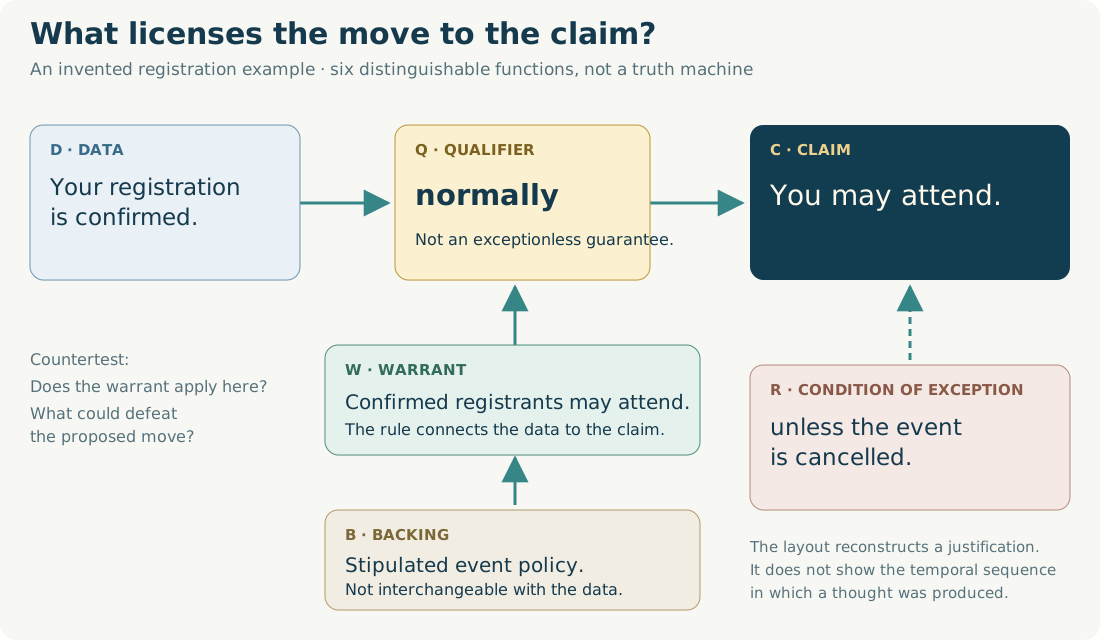
“Your registration is confirmed, so normally you may attend, unless the event is cancelled.” Confirmation supplies data; permission to attend is the claim. A registration rule supplies the warrant, while the institution's applicable policy could provide backing. “Normally” qualifies the claim and cancellation identifies an exception. This is an invented arrangement, not a statement about an actual event. The model is especially helpful when a speaker presents a conclusion as if the evidence spoke unaided. A hearer may accept the evidence but reject the proposed warrant or identify an exception. Making those possibilities visible can prevent a discussion from collapsing into the accusation that one side ignores facts. Nevertheless, a diagram is not a substitute for disciplinary knowledge. Different fields require different backing, and not every argument has six separately expressed sentences waiting to be extracted.
Movement of thought
1. Distinguish the claim from the data offered in its support. 2. Recover the warrant licensing the move between them. 3. Identify the warrant's backing and the strength claimed by a qualifier. 4. Test relevant exceptions and possible challenges to the data or warrant. 5. Revise the claim or its conditions rather than merely redrawing the diagram.
Scientific use case
Argumentation studies and educational research can use the model to reconstruct patterns of justification. Reliable coding requires explicit decisions about implicit warrants and ambiguous functions. The Atlas proposes such an application without reporting a measured educational benefit.
Example
A project team says a pilot proves its programme works. Reconstructing the argument separates the observed improvement, the general effectiveness claim and the assumption that improvement was caused by the programme. That assumption now becomes investigable instead of remaining concealed inside “proves.” Original research-planning scenario.
Counterexample
Filling every box can leave a poor inference intact. A wet pavement does not establish rain simply because a box says “rain makes pavements wet.” The reconstruction must address alternative causes and the direction of inference. A model of layout cannot supply missing evidence.
Distinction
An argument is not identical with one model of its layout. Enthymeme concerns what remains unexpressed; syllogism concerns particular inferential forms. The Toulmin model foregrounds warrants and qualifications but does not replace logic, truth assessment or specialist evidence.
Effect on thought and perception
Disagreement becomes more locatable: evidence, inferential entitlement and scope can be challenged separately. This can improve the precision of criticism without guaranteeing agreement.
Resonance
An objection can return as a qualification that improves the initial claim. Responsive reasoning need not end with either unquestioning acceptance or complete demolition.
Etymology
The heading is eponymous, identifying an analytical framework with Stephen E. Toulmin. Model names its status as a tool of representation. Neither component makes the framework a universally applicable law of reasoning.
Provenance
DE/EN editorially accepted on 16 October 2026. Historical context, language comparison and source status are shown separately in the full entry.
Cite this entry
Reich, Michael (Hrsg./ed.): „Toulmin model of argument“. Atlas der Sprache, AT-ADD-20261016-0005. ATLAS 260, data model 1.6.0. https://atlasoflanguage.com/concept/AT-ADD-20261016-0005The address remains stable; editorial content may evolve. Editorial reading state: 2026-10-16. Include your access date for precise references.
Guiding question
What licenses the step from these data to that claim, and under what conditions does the licence fail?
Five coordinate questions
These descriptions explain the entry. They are not yet controlled register values and generate no shared register results.
- Where can the process be observed?
- Reconstructed data, claim, warrant and qualifications.
- What happens to the material?
- Identify the warrant's backing and the strength claimed by a qualifier.
- At what level does a change occur?
- Disagreement becomes more locatable: evidence, inferential entitlement and scope can be challenged separately. This can improve the precision of criticism without guaranteeing agreement.
- What temporal structure is involved?
- The analytical layout need not reproduce the order in which an argument was produced.
- How can the description be tested?
- Filling every box can leave a poor inference intact. A wet pavement does not establish rain simply because a box says “rain makes pavements wet.” The reconstruction must address alternative causes and the direction of inference. A model of layout cannot supply missing evidence.
Historical context
The Uses of Argument was first published in 1958; Cambridge's account confirms its continuing interdisciplinary reception. The HWRh presents the familiar six-component layout while noting limits of the claim to model elementary arguments. This entry relies on that consulted exposition, not on an alleged full reading of every edition.
Cross-language distinction and terminology
Warrant means an inferential entitlement here, not an arrest warrant. Backing supports that entitlement; it is not interchangeable with data. The schema's rebuttal slot chiefly identifies defeating conditions, while rebuttal in ordinary debate has a wider range.
Scholarly relations: explained reading links
Each relation is named and explained. These reading links are neither shared register results nor newly canonised relation edges.
- Argument · Comparison and distinction
An argument is not identical with one model of its layout. Enthymeme concerns what remains unexpressed; syllogism concerns particular inferential forms. The Toulmin model foregrounds warrants and qualifications but does not replace logic, truth assessment or specialist evidence.
- Argumentation · Comparison and distinction
An argument is not identical with one model of its layout. Enthymeme concerns what remains unexpressed; syllogism concerns particular inferential forms. The Toulmin model foregrounds warrants and qualifications but does not replace logic, truth assessment or specialist evidence.
- Enthymeme · Comparison and distinction
An argument is not identical with one model of its layout. Enthymeme concerns what remains unexpressed; syllogism concerns particular inferential forms. The Toulmin model foregrounds warrants and qualifications but does not replace logic, truth assessment or specialist evidence.
- Syllogism (categorical) · Comparison and distinction
An argument is not identical with one model of its layout. Enthymeme concerns what remains unexpressed; syllogism concerns particular inferential forms. The Toulmin model foregrounds warrants and qualifications but does not replace logic, truth assessment or specialist evidence.
- Abduction · Comparison and distinction
An argument is not identical with one model of its layout. Enthymeme concerns what remains unexpressed; syllogism concerns particular inferential forms. The Toulmin model foregrounds warrants and qualifications but does not replace logic, truth assessment or specialist evidence.
Proposed thought pathway
What licenses the step from these data to that claim, and under what conditions does the licence fail?
Toulmin model of argument → Enthymeme → Argument from ignorance → Toulmin model of argument
Countertest and return
Filling every box can leave a poor inference intact. A wet pavement does not establish rain simply because a box says “rain makes pavements wet.” The reconstruction must address alternative causes and the direction of inference. A model of layout cannot supply missing evidence.
This route is an editorial exploration, not a necessary ordering of concepts. Return: Toulmin model of argument
Source scope and provenance
The texts are editorially accepted. Acceptance does not turn a reference article, abstract or register record into a full primary-source verification. Examples and the proposed thought sequence are independent Atlas applications.
- Historisches Wörterbuch der Rhetorik, Bd. 1, Artikel „Argument“; hg. von Gert Ueding, Tübingen: Max Niemeyer 1992. Sp. 899–900; PDF-Seite 458, mit anschließendem Vorbehalt im Referenztext · Sp. 899–900; PDF-Seite 458, mit anschließendem Vorbehalt im Referenztext
The documented article passages were rechecked against the official reference corpus: file identity, printed columns and the complete relevant PDF pages. No full-volume reading or exhaustive primary-source audit is claimed.
The article is distinct from historical originals cited within it; no exhaustive primary-source audit is claimed.
- Cambridge University Press: Stephen E. Toulmin, The Uses of Argument, aktualisierte Ausgabe · Verlagsbeschreibung: Werkbezug auf 1958; Inhalt: The Layout of Arguments
Publisher description confirms the original 1958 work and the updated edition.
No claim of reading the entire book; model components are supported by the bounded HWRh passage.
- Atlas der Sprache: Vergleichsstand Release 15.8.0 / Sites 352 · 1.211 Profile; bestätigte Vergleichs- und Ergänzungsziele
Existing comparison IDs and seven extension targets checked against the unchanged Sites 352 source export.
An editorial baseline, not an independent scholarly authority or full hosted-database equality proof.